Politics Plus is a progressive perspective. All points of view are welcome, but personal attacks against me or anyone who comments here are forbidden. Trading insults never changes anyone's mind. After over a year offline, it's great to be back! This is mostly a political blog, but on occation you will see posts about my personal life and the volunteer work I do in and out of prison as an ex-convict helping other former felons become productive, pro-social members of our communities. Enjoy!
I’ve read several rants blaming Democrats for letting Bunning get away with this, but that’s not fair. The Republican and Democratic leadership had agrees to pass this measure by unanimous consent, and most of the Senators left for the weekend. The Democratic leadership had no idea that Bunning planned this, and when he dropped the bomb, there were no longer sixty Senator’s left to override his filibuster. The net effect is that the GOP derailed several important programs in addition to cutting off unemployment benefits for thousands of workers, displaced by the GOP’s No Millionaire Left Behind program. They can now lie and say they did not know either, blaming it all on Bunning, who is not seeking reelection.
In the midst of the worst economy in decades, Republican U.S. Senator Jim Bunning last night again took to the floor of the United States Senate to block passage of legislation that would extend unemployment benefits to out-of-work Americans -- and his party is doing nothing to stop him.
It's worth watching his mean-spirited obstructionism -- and Harry Reid's and Dick Durbin's attempts to cajole him into supporting the legislation -- to get a sense of just how committed some Republicans are to doing the wrong thing for America:
Bunning is the poster-child of the most callous, heartless political party in modern American history, and they are proud of it. If they get their way, this coming Sunday, unemployment benefits will expire for countless out-of-work Americans because a handful of extremist ideologues decided to tie the U.S. Senate up in knots… [emphasis added]
For months, conservatives have been claiming that the American Recovery and Reinvestment Act (ARRA, i.e. the stimulus) is a “boondoggle” that “failed” and did not create “one new job.” But last week, the New York Times’ David Leonhardt noted that economic research firms estimate that ARRA created or saved 1.6 to 1.8 million jobs. And today, the non-partisan Congressional Research Office placed the estimate even higher, saying that ARRA is responsible for up to 2.1 million jobs in the 4th quarter of last year:
CBO estimates that in the fourth quarter of calendar year 2009, ARRA added between 1.0 million and 2.1 million to the number of workers employed in the United States, and it increased the number of full-time-equivalent jobs by between 1.4 million and 3.0 million…CBO also estimates that real (inflation-adjusted) gross domestic product (GDP) was 1.5 percent to 3.5 percent higher in the fourth quarter than would have been the case in the absence of ARRA.
CBO calculated that without the stimulus package, the unemployment rate would be up to 1.1 percent higher. It also said that unemployment is higher than analysts predicted after passage of the ARRA due to “greater-than-projected weakness in the underlying economy rather than lower-than-expected effects of ARRA.” [emphasis original]
Now we can prove it it from multiple sources. The GOP has been lying all along. The stimulus is helping. Unemployment is higher than predicted not because the stimulus failed, but because the depth and breadth of the havoc GOP policies had on our economy was worse than most realized. Former readers will remember that I said, before Obama had even won the Democratic nomination, that it would take a generation, not a single presidency to undo the damage that is the legacy of Bush and the GOP.
I wrote a college term paper for freshman level Economics, in which I suggested that the only way to fight pollution was to stop allowing polluters to externalize the costs of that pollution. My economics professor agreed and told me it was years ahead of it’s time. I sent a copy to whoever my Congressman was at the time and never received a reply. Too bad. Had they paid attention then, we would not now be facing this.
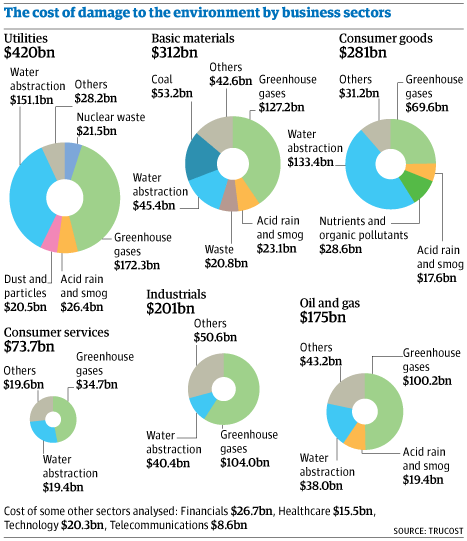
The cost of pollution and other damage to the natural environment caused by the world's biggest companies would wipe out more than one-third of their profits if they were held financially accountable, a major unpublished study for the United Nations has found.
The report comes amid growing concern that no one is made to pay for most of the use, loss and damage of the environment, which is reaching crisis proportions in the form of pollution and the rapid loss of freshwater, fisheries and fertile soils.
Later this year, another huge UN study - dubbed the "Stern for nature" after the influential report on the economics of climate change by Sir Nicholas Stern - will attempt to put a price on such global environmental damage, and suggest ways to prevent it. The report, led by economist Pavan Sukhdev, is likely to argue for abolition of billions of dollars of subsidies to harmful industries like agriculture, energy and transport, tougher regulations and more taxes on companies that cause the damage.
Ahead of changes which would have a profound effect - not just on companies' profits but also their customers and pension funds and other investors - the UN-backed Principles for Responsible Investment initiative and the United Nations Environment Programme jointly ordered a report into the activities of the 3,000 biggest public companies in the world, which includes household names from the UK's FTSE 100 and other major stockmarkets.
The study, conducted by London-based consultancy Trucost and due to be published this summer, found the estimated combined damage was worth US$2.2 trillion (£1.4tn) in 2008 - a figure bigger than the national economies of all but seven countries in the world that year.
The figure equates to 6-7% of the companies' combined turnover, or an average of one-third of their profits, though some businesses would be much harder hit than others.
"What we're talking about is a completely new paradigm," said Richard Mattison, Trucost's chief operating officer and leader of the report team. "Externalities of this scale and nature pose a major risk to the global economy and markets are not fully aware of these risks, nor do they know how to deal with them."
The biggest single impact on the $2.2tn estimate, accounting for more than half of the total, was emissions of greenhouse gases blamed for climate change. Other major "costs" were local air pollution such as particulates, and the damage caused by the over-use and pollution of freshwater.
The true figure is likely to be even higher because the $2.2tn does not include damage caused by household and government consumption of goods and services, such as energy used to power appliances or waste; the "social impacts" such as the migration of people driven out of affected areas, or the long-term effects of any damage other than that from climate change. The final report will also include a higher total estimate which includes those long-term effects of problems such as toxic waste.
Trucost did not want to comment before the final report on which sectors incurred the highest "costs" of environmental damage, but they are likely to include power companies and heavy energy users like aluminium producers because of the greenhouse gases that result from burning fossil fuels. Heavy water users like food, drink and clothing companies are also likely to feature high up on the list.
Sukhdev said the heads of the major companies at this year's annual economic summit in Davos, Switzerland, were increasingly concerned about the impact on their business if they were stopped or forced to pay for the damage.
"It can make the difference between profit and loss," Sukhdev told the annual Earthwatch Oxford lecture last week. "That sense of foreboding is there with many, many [chief executives], and that potential is a good thing because it leads to solutions."
The aim of the study is to encourage and help investors lobby companies to reduce their environmental impact before concerned governments act to restrict them through taxes or regulations, said Mattison.
"It's going to be a significant proportion of a lot of companies' profit margins," Mattison told the Guardian. "Whether they actually have to pay for these costs will be determined by the appetite for policy makers to enforce the 'polluter pays' principle. We should be seeking ways to fix the system, rather than waiting for the economy to adapt. Continued inefficient use of natural resources will cause significant impacts on [national economies] overall, and a massive problem for governments to fix."...
Inserted from <The Guardian>
An externalized cost is the part of the true cost of producing a product or service that the producer is allowed to leave for someone else to pay. Pollution is a prime example, because if taxpayers pay to clean up a toxic waste dump, if others suffer ill health due to exposure to waste products, or if costal cities drown due to global climate change, those costs have or will have been passed on to someone else.
All costs must be included in the cost of all goods and services.
But, but, but… it might put some corporations out of business!
So be it. If the true costs (with all environmental costs internal) of a product or service are so high that there is insufficient demand to support the producer, then that producer ought to fail.
But, but, but… It might cost corporations 1/3 of their profits!
So be it. If internalizing all costs cuts their profits, their profits are too high.
I have no doubt that Republicans will unanimously oppose this idea. How odd. Because what I am arguing here is really nothing more that capitalism in a free market.
For years the GOP, with the complicity of some Democrats, has used our tax code to transfer wealth from the poor and middle classes to the very rich.
For Democrats wavering in their resolve to end the Bush tax cuts for the wealthiest Americans, shocking new data from the IRS should hopefully stiffen their backbones. Between 2001 and 2007, the 400 richest taxpayers doubled their annual incomes to an average of $345 million, while their effective tax rate plummeted to only 16.6% from 29.4% in 1993.
Following recent analyses confirming that income inequality in the United States has reached record levels, noted tax journalist David Cay Johnston summed up the new data, "The incomes of the top 400 American households soared to a new record high in dollars and as a share of all income in 2007, while the income tax rates they paid fell to a record low. The numbers tell the tale of the widening chasm between the rich and everyone else:
In 2007 the top 400 taxpayers had an average income of $344.8 million, up 31 percent from their average $263.3 million income in 2006, according to figures in a report that the IRS posted to its Web site without announcement that were discovered February 16...
Adjusted for inflation to 2009 dollars, the top 400 enjoyed a 27 percent increase in their income, or nine times the rate of increase for the bottom 90 percent...Since 1992, the bottom 90 percent of Americans have seen their incomes rise by 13 percent in 2009 dollars, compared with an increase of 399 percent for the top 400.
Unsurprisingly, the public disclosure of the top 400 report first introduced by the Clinton administration was halted by President Bush (only to be reinstituted by the Obama White House last year). Unsurprising that is, because the sheer size of the massive windfall for America's rich due to the Bush tax cuts would make a Warren Buffet blush.
As the Center for American Progress noted, the Bush tax cuts delivered a third of their total benefits to the wealthiest 1% of Americans. And to be sure, their payday was staggering. The Center on Budget and Policy Priorities detailed that by 2007, millionaires on average pocketed $120,000 from the Bush tax cuts of 2001 and 2003. Those in the top 1% stashed an extra $45,000 a year. As a result, millionaires saw their after-tax incomes rise by 7.6%, while the gains for the middle quintile and bottom 20% of Americans were a paltry 2.3% and 0.4%, respectively. (Other CBPP studies demonstrated that the Bush tax cuts accounted for half of the mushrooming deficits during his tenure in the White House and will continue to do so over the next decade.)
And as the New York Times uncovered in 2006, the 2003 Bush dividend and capital gains tax cuts offered almost nothing to taxpayers earning below $100,000 a year. Instead, those windfalls reduced taxes "on incomes of more than $10 million by an average of about $500,000." As the Times revealed in a jaw-dropping chart, "the top 2 percent of taxpayers, those making more than $200,000, received more than 70% of the increased tax savings from those cuts in investment income." So it should come as no surprise that the income share of the 400 richest Americans doubled over the past decade.
And yet, the usual suspects among the Republican Party (and some quislings among the Democrats) are pleading that the rich should be spared even as their share of the national wealth reaches stratospheric levels…
I have long held that a seldom discussed cause of the Republican recession is this grotesque transfer of wealth. As the filthy rich sucked up more and more of our nation’s wealth, lower and middle class Americans found themselves getting poorer in real terms. Everything was going up except their stagnant wages. The housing bubble would never have occurred, if these Americans, encouraged by smooth-talking predators, had not felt the need to leverage the equity in their homes to educate their children, pay for their sky-rocketing health care premiums, or just maintain their standard of living.
Most economies resemble a pyramid in which a broad base holds up a small capstone. But in today’s GOP rendered economy, the capstone has become so heave that its weight is crushing the base. Until this gross inequity is addressed, there can be no escape from the bubble/crash cycle. The solution is easy enough, if we have the political will to do it. Tax the rich. For example, if rich people had Social Security and Medicare payments deducted from their entire salaries, including bonuses and stock, the solvency issue in those programs would be instantly cured.
The stimulus is beginning to work. There’s certainly more stimulus required. How do I know? If not, why are GOP politicians grubbing for the money?
The Wall Street Journal has followed up on The Washington Times report about Republican lawmakers who publicly opposed the stimulus but privately sought stimulus funds to create jobs in their states and districts. Some nuggets:
Rep. Paul Ryan, a Wisconsin Republican who called the stimulus a "wasteful spending spree" that "misses the mark on all counts," wrote to Labor Secretary Hilda Solis in October in support of a grant application from a group in his district which, he said, "intends to place 1,000 workers in green jobs."
Republican Reps. Sue Myrick of North Carolina and Jean Schmidt of Ohio sent letters in October asking for consideration of funding requests from local organizations training workers for energy-efficiency projects.
The Environmental Protection Agency received two letters from Sen. John Cornyn of Texas asking for consideration of grants for clean diesel projects in San Antonio and Houston. Mr. Cornyn is the chairman of the National Republican Senatorial Committee. One of the letters was signed jointly with Republican Sen. Kay Bailey Hutchison, also of Texas.
The agency also appeared to have received eight identical letters from Republican Sen. Bob Bennett of Utah recommending infrastructure projects in his state, seven of which were sent before stimulus legislation was passed by Congress.
The entire congressional delegation of Alabama, including its two Republican senators, wrote to then-Forest Service Chief Gail Kimbell asking for $15 million for cogongrass eradication and control programs in the state. The state ended up getting a $6.3 million grant.
It's not just the WSJ and Washington Times that are paying attention. The Minneapolis Star-Tribune reports that Gov. Tim Pawlentyused stimulus funds to balance his state's budget. TPM notes new Virginia Gov. Bob McDonnell has privately thanked the administration for offering stimulus funds to his state.
Based on these and other reports, the Obama Administration is mounting an aggressive defense of the stimulus program, pointing to the 'slam it in public, beg for it in private' hypocrisy of its Republican critics… [emphasis added]
I know you’ve seen that chart before at other blogs, but the Democratic Party sent it to me in email and asked me to spread it around, and it does fit this article perfectly. As bad as things still are, that condition is a result of the disaster Bush and the GOP left Obama and the Democrats to clean up. Long term readers who were here during the previous incarnation of Politics Plus will remember that, during the last year of the Bush/GOP regime, I often speculated that the GOP, knowing they would face major losses in 2008, intentionally allowed the economy to tank, even including the misuse of their half of TARP spending, to leave a mess behind that was so bad that they could blame Democrats for the effects of their own policies and use that blame in an attempt to regain power. While In have no proof that was their intent, inductive logic indicates likelihood. Look at that chart again. Things are not as bad as they used to be.
Bear in mind that these reports of GOP duplicity regarding the stimulus are not coming from left wing sources. Both papers are bastions of the right.
Two of my favorite people had a field day with this story.
First, here’s Rachel Maddow with DNC Chair, Tim Kaine.
Now the next time a rabid right winger tells you that the stimulus is _________ [insert GOP lie at hand], you are now armed with the truth. Let them have it with both barrels.
Not much of this is new, but the article provides good overall perspective.
Reckless greed on Wall Street is a dog-bites-man story. Still, the renewed feeding frenzy of the alpha dogs of finance in the embers of the bonfire of their own vanities has inspired amazement and disgust across the political spectrum.
Despite the damage it yet may cause, though, the spectacle does seem to be helping to disarm some of the banksters' ideological weaponry. In the debate over why the financial system collapsed and how to rebuild it, economic assumptions that have enjoyed hegemony for the past 30 years are being questioned, and a swelling chorus is supporting a return to stronger regulation.
David Stockman, President Ronald Reagan's director of the Office of Management and Budget, recently weighed in: "The baleful reality is that the big banks, the freakish offspring of the Fed's easy money, are dangerous institutions, deeply embedded in a bull market culture of entitlement and greed."
Stockman welcomed President Barack Obama's proposed tax on banks because its message is that "big banking must get smaller because it does too little that is useful, productive or efficient."
While the United States economy remains mired in a weak, jobless recovery, the financial sector has used its political clout and government largesse to once again go for the gusto. In the third quarter of 2009, according to economist Dean Baker, finance grabbed 34 percent of all U.S. corporate profits, a far bigger share than at the peak of the housing bubble.
In the political arena, too, Wall Street is back in force. As Congress debates proposals for financial re-regulation, the financiers have cried "Havoc" and let slip the canines of K Street against the reforms.
At Goldman Sachs, the leader of the pack, any embarrassment over the savaging of the global economy is well-hidden. The investment bank, popularly dubbed "Goldman Calf", reportedly has given its employees some 13 billion dollars in bonuses for 2009. That nearly triples its largesse in 2008 when, according to the Wall Street Journal, 953 employees received bonuses of over one million dollars each.
The bank reported earnings of 13.4 billion dollars for 2009, nearly matching the 15 billion dollars combined total of the five other biggest banks. Its net profit margin was 23.85 percent.
Goldman received 10 billion dollars in funds from the U.S. government's Troubled Asset Relief Program in 2008, which it paid back with interest in 2009. The firm also benefited from other forms of government generosity, including an estimated 12.9 billion dollars as a counterparty of AIG.
The failed insurance behemoth used bailout funds to pay off credit default swaps and other complex wagers on bond markets at allegedly inflated values to Goldman and several other U.S. and European financial giants. For some time before the crash, GS had reportedly been betting against the mortgage market.
The apotheosis of Goldman Sachs has relied on a revolving door between the firm and lofty precincts of the federal government. Henry Paulson, the George W. Bush administration's secretary of the Treasury responsible for TARP, formerly served as the firm's CEO. Robert Rubin, Treasury Secretary under President Bill Clinton, and many other power brokers in both major parties are also alumni.
A long year after the industry's near-death experience, Goldman's glass is either full or overflowing, depending on how you look at it. So is popular anger against it. Rolling Stone magazine writer Matt Taibbi celebrated the investment bank as "a giant vampire squid wrapped around the face of humanity, relentlessly jamming its blood funnel into anything that smells like money."
Satirist Andy Borowitz reported tongue-in-cheek that Goldman was in talks to buy the Treasury Department. He quoted an apocryphal Treasury spokesman as saying that the merger would create efficiencies for both because of the high volume of employees and money already flowing back and forth between them. The only hard part, the spokesman said, "is trying to figure out which parts of the Treasury Department we don't already own."
Belatedly, Obama and the Democrats seem to have decided that popular anger on the right and the left churned up by the financial industry may be a political wave they can ride.
In December, the House of Representatives passed a bill that would create an independent financial protection agency for consumers, a measure long lobbied for by Harvard law professor Elizabeth Warren, director of the Congressional Oversight Panel for the bank bailout.
The legislation would also increase banks' capital requirements and limit their leverage, the extent of their reliance on borrowed funds. And by requiring lenders to hold on to some proportion of the loans they make, the law would restrict securitization, the practice of bundling mortgages into complex derivatives that frequently have turned toxic, dragging down financial institutions that hold them.
In the Senate, though, prospects for 60 votes to break a potential filibuster look dubious. Republicans appear to be nearly unanimous in their opposition to the reforms…
I’ve discussed my solutions enough times that I won’t repeat them today, but one thing is clear. The only way to accomplish even minimal banking reform is through reconciliation.
I have a pair of excellent videos for you today. In the first, Rachel Maddow and Chris Hayes nail Susan Collins and other GOP Senators for their lies about the handling of the underpants bomber:
What we see here is GOP desperation. For years they have hoodwinked Americans into believing that they are the national security party, even though the second worst national security disaster (after Pearl Harbor) in US history occurred through incompetence on their watch. They insisted that EITs (torture) were necessary to get the intelligence needed to keep America safe, even though most experts on interrogation agree that EITs produce faulty intelligence. They belittled claims by Democrats that following the law is the best way to proceed and called us weak on terrorism. Now that the bomber is singing like a canary, the proof that the Democrats were right is staring them in the face, and they are besides themselves. So they are lying.
In the second, Keith exposes the Frank Luntz memo, instructing Republicans to lie about finance reform.
Why do Republicans lie so much? I was thinking about that as I commented on another blog yesterday, and the answer came to me. It’s simple. If Republicans told the truth, nobody in their right mind would vote for them.
Here are some of the highlights of Obama’s 2011 budget:
...
Some highlights:
$25 billion for state governments to meet Medicaid costs.
$33 billion in additional funds this year for the wars in Afghanistan and Iraq, and a budget of $159 billion for those conflicts in 2011, $46 billion more than the 2010 budget. The overall increase in the 2011 vs. the 2010 Pentagon budget: $44 billion.
$28 billion for elementary and secondary education programs, a $3 billion increase.
$17 billion more for Pell grants to students in higher education.
$61.6 billion for civilian research and development, a $3.7 billion increase over this year.
$43.6 billion for the Department of Homeland Security, a 2% increase. This will include $734 million for 1,000 advanced imaging machines to enhance airport security.
$100 billion in small-business tax cuts.
$37 billion increase in taxes for oil and gas companies over the next nine years.
$20 billion saved through cuts in some 120 programs, including folding 38 education programs into 11, cutting the National Park Service's Save America's Treasures and Preserve America grant program, cutting the Brownfields Economic Development Initiative, which converts decayed former industrial sites to new uses, and getting rid of the Advanced Earned Income Tax Credit, which allows low-wage workers to get tax-credit checks in advance.
No return to the moon for NASA.
A boost in the top two tax brackets from 33% and 35% to 36% and 39.6%, respectively.
Families that make $250,000 or more would see their capital-gains and dividend tax rates rise from 15% to 20%.
Hedge-fund and private-equity traders now pay capital gains on their fees would be taxes at higher income-tax rates.
Corporations would pay extra taxes on overseas earnings, amounting to more than $120 billion over the next decade.
I don’t agree with everything in this budget. If any president were to submit a budget with which I fully agree, the shock could be terminal. But this budget seems to be harder on Wall Street than on Main Street.
The GOP doesn’t know which way to turn, as Keith Olbermann discusses with Howard Fineman.
PRESIDENT OBAMA 10 days ago set out one important element in the needed structural reform of the financial system. No one can reasonably contest the need for such reform, in the United States and in other countries as well. We have after all a system that broke down in the most serious crisis in 75 years. The cost has been enormous in terms of unemployment and lost production. The repercussions have been international.
Aggressive action by governments and central banks — really unprecedented in both magnitude and scope — has been necessary to revive and maintain market functions. Some of that support has continued to this day. Here in the United States as elsewhere, some of the largest and proudest financial institutions — including both investment and commercial banks — have been rescued or merged with the help of massive official funds. Those actions were taken out of well-justified concern that their outright failure would irreparably impair market functioning and further damage the real economy already in recession.
Now the economy is recovering, if at a still modest pace. Funds are flowing more readily in financial markets, but still far from normally. Discussion is underway here and abroad about specific reforms, many of which have been set out by the United States administration: appropriate capital and liquidity requirements for banks; better official supervision on the one hand and on the other improved risk management and board oversight for private institutions; a review of accounting approaches toward financial institutions; and others.
As President Obama has emphasized, some central structural issues have not yet been satisfactorily addressed.
A large concern is the residue of moral hazard from the extensive and successful efforts of central banks and governments to rescue large failing and potentially failing financial institutions. The long-established “safety net” undergirding the stability of commercial banks — deposit insurance and lender of last resort facilities — has been both reinforced and extended in a series of ad hoc decisions to support investment banks, mortgage providers and the world’s largest insurance company. In the process, managements, creditors and to some extent stockholders of these non-banks have been protected.
The phrase “too big to fail” has entered into our everyday vocabulary. It carries the implication that really large, complex and highly interconnected financial institutions can count on public support at critical times. The sense of public outrage over seemingly unfair treatment is palpable. Beyond the emotion, the result is to provide those institutions with a competitive advantage in their financing, in their size and in their ability to take and absorb risks.
As things stand, the consequence will be to enhance incentives to risk-taking and leverage, with the implication of an even more fragile financial system. We need to find more effective fail-safe arrangements.
In approaching that challenge, we need to recognize that the basic operations of commercial banks are integral to a well-functioning private financial system. It is those institutions, after all, that manage and protect the basic payments systems upon which we all depend. More broadly, they provide the essential intermediating function of matching the need for safe and readily available depositories for liquid funds with the need for reliable sources of credit for businesses, individuals and governments.
Combining those essential functions unavoidably entails risk, sometimes substantial risk. That is why Adam Smith more than 200 years ago advocated keeping banks small. Then an individual failure would not be so destructive for the economy. That approach does not really seem feasible in today’s world, not given the size of businesses, the substantial investment required in technology and the national and international reach required.
Instead, governments have long provided commercial banks with the public “safety net.” The implied moral hazard has been balanced by close regulation and supervision. Improved capital requirements and leverage restrictions are now also under consideration in international forums as a key element of reform.
The further proposal set out by the president recently to limit the proprietary activities of banks approaches the problem from a complementary direction. The point of departure is that adding further layers of risk to the inherent risks of essential commercial bank functions doesn’t make sense, not when those risks arise from more speculative activities far better suited for other areas of the financial markets.
The specific points at issue are ownership or sponsorship of hedge funds and private equity funds, and proprietary trading — that is, placing bank capital at risk in the search of speculative profit rather than in response to customer needs. Those activities are actively engaged in by only a handful of American mega-commercial banks, perhaps four or five. Only 25 or 30 may be significant internationally.
Apart from the risks inherent in these activities, they also present virtually insolvable conflicts of interest with customer relationships, conflicts that simply cannot be escaped by an elaboration of so-called Chinese walls between different divisions of an institution. The further point is that the three activities at issue — which in themselves are legitimate and useful parts of our capital markets — are in no way dependent on commercial banks’ ownership. These days there are literally thousands of independent hedge funds and equity funds of widely varying size perfectly capable of maintaining innovative competitive markets. Individually, such independent capital market institutions, typically financed privately, are heavily dependent like other businesses upon commercial bank services, including in their case prime brokerage. Commercial bank ownership only tilts a “level playing field” without clear value added.
Very few of those capital market institutions, both because of their typically more limited size and more stable sources of finance, could present a credible claim to be “too big” or “too interconnected” to fail. In fact, sizable numbers of such institutions fail or voluntarily cease business in troubled times with no adverse consequences for the viability of markets.
What we do need is protection against the outliers. There are a limited number of investment banks (or perhaps insurance companies or other firms) the failure of which would be so disturbing as to raise concern about a broader market disruption. In such cases, authority by a relevant supervisory agency to limit their capital and leverage would be important, as the president has proposed.
To meet the possibility that failure of such institutions may nonetheless threaten the system, the reform proposals of the Obama administration and other governments point to the need for a new “resolution authority.” Specifically, the appropriately designated agency should be authorized to intervene in the event that a systemically critical capital market institution is on the brink of failure. The agency would assume control for the sole purpose of arranging an orderly liquidation or merger. Limited funds would be made available to maintain continuity of operations while preparing for the demise of the organization.
To help facilitate that process, the concept of a “living will” has been set forth by a number of governments. Stockholders and management would not be protected. Creditors would be at risk, and would suffer to the extent that the ultimate liquidation value of the firm would fall short of its debts.
To put it simply, in no sense would these capital market institutions be deemed “too big to fail.” What they would be free to do is to innovate, to trade, to speculate, to manage private pools of capital — and as ordinary businesses in a capitalist economy, to fail.
I do not deal here with other key issues of structural reform. Surely, effective arrangements for clearing and settlement and other restrictions in the now enormous market for derivatives should be agreed to as part of the present reform program. So should the need for a designated agency — preferably the Federal Reserve — charged with reviewing and appraising market developments, identifying sources of weakness and recommending action to deal with the emerging problems. Those and other matters are part of the administration’s program and now under international consideration.
In this country, I believe regulation of large insurance companies operating over many states needs to be reviewed. We also face a large challenge in rebuilding an efficient, competitive private mortgage market, an area in which commercial bank participation is needed. Those are matters for another day.
What is essential now is that we work with other nations hosting large financial markets to reach a broad consensus on an outline for the needed structural reforms, certainly including those that the president has recently set out. My clear sense is that relevant international and foreign authorities are prepared to engage in that effort. In the process, significant points of operational detail will need to be resolved, including clarifying the range of trading activity appropriate for commercial banks in support of customer relationships.
I am well aware that there are interested parties that long to return to “business as usual,” even while retaining the comfort of remaining within the confines of the official safety net. They will argue that they themselves and intelligent regulators and supervisors, armed with recent experience, can maintain the needed surveillance, foresee the dangers and manage the risks.
In contrast, I tell you that is no substitute for structural change, the point the president himself has set out so strongly…
Cousin FatCat, the Bankster, does not agree with Volker. He agrees with Tim Geithner. He wants business as usual, so he can get new diamonds with which to fill his litter box. Why do you think he does not like Volker?
The Battle of Thermopylae resonates from the history of ancient Greece, and reminds me of Obama’s battle yesterday.
...Leonidas is best known for his heroic defense of the narrow mountain pass of Thermopylae against the Persian army of Xerxes I in 480 bc. With an outnumbered force of about 7000 men, of which 300 were Spartans, Leonidas withstood the Persian invasion for two days. A Thessalian traitor, Ephialtes (d. 469 bc), however, showed Xerxes a new path over the mountain, and when Leonidas learned that he was about to be attacked from the rear, he sent most of his troops to safety. He remained with the Spartans and about 1100 other soldiers, mainly Thebans and Thespians, who refused to leave. The Thebans subsequently deserted. Leonidas and the remainder of his men perished bravely. The famous Battle of Thermopylae was recorded by the Greek historian Herodotus in his History…
There are similarities and differences of course. Both heroically faced overwhelming odds. Both were betrayed. But Leonidas had only one traitor, Ephialtes. Obama has LIEberman and all the blue dogs that helped kill the public option and held out for back room deals. Leonidas chose the ground to defend, but Obama went into enemy territory. The biggest difference is that, in the end, Leonidas lost the battle.
In a remarkably sharp face-to-face confrontation, President Barack Obama chastised Republican lawmakers Friday for opposing him on taxes, health care and the economic stimulus, while they accused him in turn of brushing off their ideas and driving up the national debt.
The president and GOP House members took turns questioning and sometimes lecturing each other for more than an hour at a Republican gathering in Baltimore. The Republicans agreed to let TV cameras inside, resulting in an extended, point-by-point interchange that was almost unprecedented in U.S. politics, except perhaps during presidential debates.
With voters angry about partisanship and legislative logjams, both sides were eager to demonstrate they were ready to cooperate, resulting in the GOP invitation and Obama's acceptance. After polite introductions, however, Friday's exchange showed that Obama and the Republicans remain far apart on key issues, and neither side could resist the chance to challenge and even scold the other.
Obama said Republican lawmakers have attacked his health care overhaul so fiercely, "you'd think that this thing was some Bolshevik plot." His proposals are mainstream, widely supported ideas, he said, and they deserve some GOP votes in Congress.
"I am not an ideologue," the president declared.
But Rep. Tom Price, R-Ga., pointedly asked Obama: "What should we tell our constituents who know that Republicans have offered positive solutions" for health care, "and yet continue to hear out of the administration that we've offered nothing?"
Obama showed little sympathy, disputing Price's claim that a Republican plan would insure nearly all Americans without raising taxes.
"That's just not true," said Obama. He called such claims "boilerplate" meant to score political points.
At times it seemed more like Britain's "question time" — when lawmakers in the House of Commons trade barbs with the prime minister — than a meeting between a U.S. president and members of Congress.
Republican Conference Chairman Mike Pence of Indiana defended Price on the health care proposals. He said a GOP agenda booklet given to Obama at the start of the session "is backed up by precisely the kind of detailed legislation that Speaker (Nancy) Pelosi and your administration have been busy ignoring for 12 months."
Obama shot back that he had read the Republican proposals and that they promise solutions that can't be realized.
In another barbed exchange, the president said some Republican lawmakers in the audience had attended ribbon-cutting ceremonies for projects in their districts funded by the 2009 stimulus package that they voted against.
Pence said Obama was trying to defend "a so-called stimulus that was a piecemeal list of projects and boutique tax cuts."
Obama replied, "When you say they were boutique tax cuts, Mike, 95 percent of working Americans got tax cuts."
"This notion that this was a radical package is just not true," he said.
Republicans are feeling energized after winning a Democratic Senate seat in Massachusetts, and Obama is trying to refocus his stalled agenda more on jobs than health care. With Obama at a podium facing a hotel conference room full of Republicans, both sides jumped to the debate.
"It was the kind of discussion that we frankly need to have more of," said House Republican Whip Eric Cantor of Virginia.
"I'm having fun, this is great," Obama said when Pence asked if he had time for more questions.
"So are we," said Pence.
Some Republicans prefaced their questions with lengthy recitations of conservative talking points. The president sometimes listened impassively but sometimes broke in.
"I know there's a question in there somewhere, because you're making a whole bunch of assertions, half of which I disagree with," Obama said to Rep. Jeb Hensarling of Texas, whom he mistakenly called "Jim."
Obama, a former law school professor, launched into lectures of his own at times. He warned lawmakers from both parties against demonizing a political opponent, because voters might find it incomprehensible if the two sides ever agree on anything.
"We've got to be careful about what we say about each other sometimes, because it boxes us in in ways that makes it difficult for us to work together because our constituents start believing us," Obama said. "So just a tone of civility instead of slash-and-burn would be helpful."
Republicans sat attentively for the most part. There was some grumbling when Obama remarked — after being pressed about closed-door health care negotiations — that much of the legislation was developed in congressional committees in front of television cameras.
"That was a messy process," Obama said.
GOP lawmakers pressured him to support a presidential line-item veto for spending bills and to endorse across-the-board tax cuts. Obama said he was ready to talk about the budget proposal, though he disputed accusations that his administration was to blame for big increases in deficit spending. And he demurred on the idea of cutting everyone's taxes, saying with a smile that billionaires don't need tax cuts.
In his opening remarks, Obama criticized what he said was a Washington culture driven by opinion polls and nonstop political campaigns.
"I don't believe that the American people want us to focus on our job security, they want us to focus on their job security," he said… [emphasis added]
One phrase the GOP has bantered around quite a bit of late is boutique tax cut. In GOP-speak that is any tax cut in which the richest 5% do not get at least 90% of the benefit.
Here’s a video excerpt with some fact checking by Rachel Maddow.
My findings were similar to hers. I went to the GOP site and, after disabling a swarm of persistent tracking cookies, downloaded it the same pamphlet given to Obama with all the ideas they claim to have. Reading it was a lot like looking at The GOP’s Silicone Sweetie, Carrie Prejean. Their points, like hers, are pretty to look at, but nothing there is real. There’s lots of fluff, but no substance. The few ideas that they did spell out in any detail are the same tired policies that brought this nation to its current sorry state.
Obama clearly won the day, In the words of a Republican who was there, "It was a mistake that we allowed the cameras to roll like that. We should not have done that."
The economy grew at a faster-than-expected 5.7 percent pace in the fourth quarter, the quickest pace in more than six years, as businesses reduced inventories less aggressively, the Commerce Department said on Friday.
The first estimate put fourth-quarter gross domestic product growth at its fastest pace since the third quarter of 2003. The economy expanded at a 2.2 percent annual rate in the third quarter.
Analysts polled by Reuters had forecast GDP, which measures total goods and services output within U.S. borders, growing at a 4.6 percent rate in October-December period.
Growth was boosted a sharp slowdown in the pace of inventory liquidation, a factor that could mask the strength of the economic recovery from the longest and deepest downturn since the Great Depression…
The GOP won’t see the evidence here that the stimulus plan is starting to produce results, because like ostriches, they also have keep their heads somewhere the sun doesn’t shine.
In my opinion, Barack Obama hit a home run with his State of the Union address last night. I do not agree with everything he said. However, I respect opposing points of view. My most serious criticism is that he is still clinging to bipartisanship and gave Republicans far more respect than they deserve. However, he made it clear that he took office in the midst of crises, and that the vast majority of debt under his administration was from enacting the bailout passed before he became President. He made fools of the Republicans be enumerating the many tax cuts that have been enacted under his administration. Because Republicans parrot “middle class tax cut” continually, they could not object. They had to be fuming, because in GOP-speak “Middle Class Tax Cut” means “Tax Cut for the Rich”. Obama’s tax cuts really were for the middle class. I also liked the way he lampooned the Senate, by listing all the bills the House has passed and making it clear that inaction by the Senate is the sticking point. I liked the way he called on Congress to end Don’t Ask, Don’t Tell. Although he could simply instruct the military not to enforce it, it is the law. If he did, he would let Congress off the hook, and leave the law on the books for some future administration to enforce. Congress passed it. Rescinding it is their obligation, one which I fully support. He also made it clear that Republicans are engaging in pure obstructionism, and made it clear that if they continue that tactic, they will have to answer to voters for it.
Keith Olbermann’s coverage excelled, as usual. Here are two videos. The first is with Howard Fineman:
According to a CBS News Poll, 83% of those interviewed approved of Obama’s proposals. Only 17% did not.
Virginia Gov. Bob McDonnell gave the Republican response. McClatchy also has the full text of his speech. While more respectful, better constructed, and better delivered that the Bobby Jindal fiasco after Obama’ last address to Congress, it contained only the standard GOP talking points. One thing was clear. McDonnell had not even listened to Obama’s speech before responding, because he did not know that Obama had put domestic fossil fuel development on the table.
Republicans were also polled. ;-)
(The Borowitz Report) - President Barack Obama's State of the Union address has already gotten a big thumbs-down from one key group of voters: Republicans who did not see the speech.
According to an instant poll conducted by the University of Minnesota's Opinion Research Institute, 90 percent of Republicans who did not see the President's speech strongly disagreed with it.
Additionally, 95 percent of Republicans polled agreed with the statement, "If I had seen the President's speech, I'll bet I would have hated it even more."
Davis Logsdon, who supervised the poll, said there were certain difficulties in polling Republican voters: "Many of them would not let us finish asking the question before answering 'No.'"… [emphasis added]
Although Joe “You Lie” Wilson, promised to be on his best behavior, these Republican leaders just don’t seem to understand is that there are people watching who are trained to read lips.
Tonight in his State of the Union address, President Obama outlined steps he plans to take “to pay for the $1 trillion that it took to rescue the economy last year.” However, he first addressed right-wing criticisms that he is overseeing out-of-control spending by noting the situation he faced when he took office:
By the time I took office, we had a one year deficit of over $1 trillion and projected deficits of $8 trillion over the next decade. Most of this was the result of not paying for two wars, two tax cuts, and an expensive prescription drug program. On top of that, the effects of the recession put a $3 trillion hole in our budget. All this was before I walked in the door.
The camera then cut to Sen. John McCain (R-AZ), who leaned over to Sen. Lindsey Graham (R-SC) and appeared to whisper, “Blame it on Bush.” The two men then laughed. Watch it:
That was John “McConJob” McCain’s best act since singing “Bomb, Bomb Iran” into a mike he did not know was open.
But even worse was the despicable breech of decorum by reactionary-right activist Justice Samuel Alito.
Justice Samuel A. Alito Jr. responded to President Obama's criticism Wednesday night of a Supreme Court decision last week by appearing to mouth the words "not true."
Obama took issue with a ruling that overturned two of the court's precedents and upended decades of restrictions on corporations being able to use their profits to finance campaigns for and against candidates.
It proved to be a striking State of the Union moment: With six justices seated in their black robes directly in front of him in the House chamber, Obama said: "With all due deference to separation of powers, last week the Supreme Court reversed a century of law that, I believe, will open the floodgates for special interests, including foreign corporations, to spend without limit in our elections."
As Democrats applauded, cameras showed the justices sitting expressionless. Except Alito.
"Not true, not true," he appeared to say, as he shook his head.
"I don't think American elections should be bankrolled by America's most powerful interests or, worse, by foreign entities," Obama continued. "They should be decided by the American people. And I urge Democrats and Republicans to pass a bill that helps correct some of these problems."
The court's 5 to 4 decision, in which Alito was in the majority, said it did not have to address the question of electoral spending by foreign firms, because the law being considered did not differentiate between domestic and foreign corporations... [emphasis added]
I was impressed with Obama for taking on the Supreme Court to their faces for that horrid decision. While technically the court did not have to address the question of electoral spending by foreign firms, as Alito said, what Alito did not say, a lie by omission, is more important. The court did not have to address the question of electoral spending by domestic firms either. The only question before the court was whether or not broadcasting a single film crossed the line under settled law, well established by precedent. This decision was judicial activism at its worst, and Obama said so.
In summery, the speech was masterful. It was not what I would have said, but although I consider myself a wordsmith, Obama’s talents surpass mine far and away. What remains to be seen is whether or not he follows it up with appropriate action. I’m willing to give him the benefit of the doubt, which I admit is considerable.
Five days ago I encouraged support for Oregon Measures 66 and 67. I’m happy to announce that both passed.
Oregon voters bucked decades of anti-tax and anti-Salem sentiment Tuesday, raising taxes on corporations and the wealthy to prevent further erosion of public schools and other state services.
The tax measures passed easily, with late returns showing a 54 percent to 46 percent ratio. Measure 66 raises taxes on households with taxable income above $250,000, and Measure 67 sets higher minimum taxes on corporations and increases the tax rate on upper-level profits.
The results triggered waves of relief from educators and legislative leaders, who were facing an estimated $727 million shortfall in the current two-year budget if the measures failed.
"We're absolutely ecstatic," said Hanna Vandering, a physical education teacher from Beaverton and vice president of the statewide teachers union. "What Oregonians said today is they believe in public education and vital services."
The double-barreled victory is the first voter-approved statewide income tax increase since the 1930s. Other states, facing similar budget woes, are watching the outcome closely because Oregon, after all, is a state that capped property taxes and locked a surplus tax rebate program into the constitution… [emphasis added]
The people of Oregon, although progressive in many ways, have a long standing antipathy to taxes. Nevertheless, we recognized that it’s time for the rich, including corporations, to pay more. We saw through an onslaught of rabid-right advertising laden with lies. We have set the example for America. Follow our lead!
In tomorrow’s State of the Union address, Obama plans to address the Bush/GOP deficit.
Looking to signal at least one step toward reining in huge federal budget deficits, President Barack Obama will propose a three-year freeze in non-security discretionary spending, senior administration officials said Monday.
His budget proposal, to be unveiled in part with Wednesday's State of the Union speech and in detail next week, will urge Congress to keep overall spending at $447 billion a year for agencies other than those charged with national security and mandatory-spending programs such as Social Security and Medicare.
The freeze would take effect with the 2011 fiscal year starting Oct. 1, and wouldn't affect the $787 billion economic stimulus plan already being implemented, the officials said.
It also wouldn't affect a $154 billion jobs plan pending before Congress and backed by Obama, the officials said. One aide said that plan would be exempt because it would take effect this year, before the freeze.
Administration officials, who spoke on the condition of anonymity to not upstage the president, said that the three-year freeze would save $250 billion over a decade — if it's approved by an election-year Congress.
After three years, the total spent would be the lowest as a percentage of the total economy in 50 years. Spending on those agencies has increased by an average of 5 percent a year since 1993, the officials said… [emphasis added]
My knee-jerk reaction to this was to think he’s loony as a Tea bugger! Reduce spending during a recession is a GOP solution. Consider Hoover. After listening to a couple progressives, I decided to reserve judgment. The details will show. Our government is awash in corporate welfare. It would be possible for Obama to increase programs for Main Street and still achieve the savings by cutting the GOP’s No Millionaire Left Behind spending. So I’m going to wait and see how it develops before ASSuming the worst.
I'm just a retreaded activist from the 1960s trying to promote progressive values one day at a time, remove the GOP stranglehold on our nation, and insist that Democrats stop acting like Republicans.