Politics Plus is a progressive perspective. All points of view are welcome, but personal attacks against me or anyone who comments here are forbidden. Trading insults never changes anyone's mind. After over a year offline, it's great to be back! This is mostly a political blog, but on occation you will see posts about my personal life and the volunteer work I do in and out of prison as an ex-convict helping other former felons become productive, pro-social members of our communities. Enjoy!
Showing posts with label Corporate Criminals. Show all posts
Showing posts with label Corporate Criminals. Show all posts
If you have not seen this, watch it. If you have, watch it again. I wish every Senator and Representative would watch this. I have nothing else to say, because my words would only lessen the impact of his.
She raises an excellent point. The sole purpose for their existence is to make as much money as they can. What she does not say here is that it is the same reason corporations should not have the same political rights as people, since corporate interest and public interest are diametrically opposed.
Finally, Anthony Weiner ripped into the Republicans like gangbusters!
Peter DeFazio is a Representative from Oregon, and was the one granting Weiner time. Did you see the grin on his face when Weiner was done? What a grin! I’d have to munch down half the birds in the Western Hemisphere to have a grin like that! Bravo Weiner!!
I suspect that everyone will be posting an analysis of Obama’s proposed fixes to the Senate bill. I like most of them, but rather than duplicating many efforts, I’d like to look at what the upcoming summit means.
“This new Democrats-only backroom deal doubles down on the same failed approach that will drive up premiums, destroy jobs, raise taxes, and slash Medicare benefits,” said House Minority Leader John A. Boehner (R-Ohio). “This week’s summit clearly has all the makings of a Democratic infomercial for continuing on a partisan course.”
What’s interesting about this official response is that it appears to fall directly into a trap that the White House has been quite candid about in their off-the-record comments. The White House is using this summit on Thursday to “shine a light” on the lack of any serious counterproposals from the Republicans. They will also be able to demonstrate that independent experts disagree with Republican assertions that the proposed legislation will drive up premiums, increase the budget deficit, create death panels, raise taxes (except on the wealthiest Americans), or slash Medicare benefits.
There’s a basic clash that is being set up on the White House’s terms. On the one side, the White House is presenting this as a situation where health care reform is going to pass. That aspect is removed as part of the debate. All that remains to decide is what precisely will be in the legislation. On the other side, the Republicans simply want to defeat any health care reform, no matter what is in the bill. But that position violates the entire premise and spirit of the summit, including its aspirational bipartisanship. It also means that the Republicans do not concede that some reform is urgently needed. That’s why the Blue Anthem rate hikes of 39% are being put forward by the White House. How can hikes that large not require a response?
The Republicans had already convinced their supporters that the battle to kill health care reform was won. This puts them in a bind. How can they concede that something needs to pass? How can they accept the very premise of the summit that they feel politically compelled to attend? Yet, if they do attend the summit and they behave in the way they’ve been behaving, they’ll be sharply corrected by representatives of the Office of Management and Budget, the Congressional Budget Office, and the Joint Committee on Taxation.
It appears that the Republicans are headed full-steam into a political trainwreck. If they engage seriously during the summit, embracing the premise that reform needs to pass, they’ll enrage their base beyond description. But if they petulantly refuse to accept the premise and keep repeating their mantra that the American people have already rejected reform, they’ll come off exactly the way the White House wants them to come off. And then the Democrats will have renewed momentum for passing a bill under reconciliation rules…
The President’s plan has one huge fault. It lacks a public option, despite wide-spread public support for it:
…A batch of state polls by the non-partisan Research 2000 shows that in multiple states represented by key Dem Senators who will have to decide whether to support reconciliation, the public option polls far better than the Senate bill does, often by lopsided margins.
Here’s a rundown, sent over by the Progressive Change Campaign Committee, which commissioned the polls:
* In Nevada, only 34% support the Senate bill, while 56% support the public option.
* In Illinois, only 37% support the Senate bill, while 68% support the public option.
* In Washington State, only 38% support the Senate bill, while 65% support the public option.
* In Missouri, only 33% support the Senate bill, while 57% support the public option.
* In Virginia, only 36% support the Senate bill, while 61% support the public option.
* In Iowa, only 35% support the Senate bill, while 62% support the public option.
*In Minnesota, only 35% support the Senate bill, while 62% support the public option.
* In Colorado, only 32% support the Senate bill, while 58% support the public option.
When the White House unveiled its new proposal to take to the summit, it did not include a public option, as expected. Obviously, including one would have made it easier for Republicans to argue that Dems aren’t making a good-faith effort to compromise, since the public option is the centerpiece of the dreaded “government takeover” that Republicans have warned against.
But if the summit yields no compromises, and Dems decide to forge ahead on their own and pass reform via reconciliation, including the public option at that point might make some political sense, if the above polls are to be believed.
At least it’s good to know that someone in government cares about our nation’s best interests.
Two congressional lawmakers have announced legislation that would effectively remove military contractors from war zones.
Sen. Bernie Sanders (I-VT) and Rep. Jan Schakowsky (D-IL) introduced the "Stop Outsourcing Security Act" on Tuesday. If passed, the act would force the United States to phase out its controversial use of private security contractors in war zones like Iraq and Afghanistan.
"The legislation would restore the responsibility of the American military to train troops and police, guard convoys, repair weapons, administer military prisons, and perform military intelligence," the lawmakers' offices said.
"The bill also would require that all diplomatic security be undertaken by US government personnel," they added.
While the bill is likely to meet stiff opposition from the Pentagon and the defense industry, it's certain to be well received among progressives and peace activists, who have watched with alarm as the use of private contractors in war zones has skyrocketed in recent years.
Last month, a report (PDF) from the Congressional Research Service found that one-fifth of the US armed forces in Iraq consists of private contractors, while in Afghanistan that number reached one-third by September of 2009.
The report found that there were some 22,000 "armed private security contractors" in the two war zones, and that the number in Afghanistan is likely to keep growing.
While "[m]any analysts and government officials believe that DOD would be unable to execute its mission without PSCs," the report stated that the "use of armed contractors has raised a number of issues for Congress, including concerns over transparency and accountability."
"It is inexcusable that as much as one-third of our military’s armed force in Afghanistan may be contractors," Schakowsky wrote to Defense Secretary Robert Gates, following the report's release. "These men and women are not part of the US military or government. They do not wear the uniform of the United States, though their behavior has, on numerous occasions, severely damaged the credibility and security of our military and harmed our relationship with other governments."
This is not the first time that Schakowsky has attempted to end the growing tradition of private contractors fighting public wars. In 2007, she introduced a bill, with the same name as the new one, which would have phased out the use of contractors over a number of years. The bill never made it out of committee...
Our fine military personnel are the best suited to do these jobs. They perform far better. They are accountable. They cost far less than mercenary thugs accountable only to corporate criminals. While this bill will never see the light of day, I thank Senator Sanders and Representative Schakowsky for introducing it.
Obama has once again called for bipartisanship in the Thursday’s HCR conference.
I expect one of three things to happen.
Door Number 1:
Obama could cave in to GOP demands. While this would cause consternation on the GOP, because they would have to immediately about face and pretend that they now and have always opposed whatever those demands are. Such a move would doom Obama’s presidency by alienating the mainstream, let alone his base.
Door Number 2:
Obama will present what is essentially BARF (Baucus Against a Real Fix). The GOP would oppose it, as do the majority of Americans. It would probably fail to pass and doom Obama’s presidency for the same reasons.
Door Number 3:
The last and best possibility is that Obama will introduce a compromise between the House and Senate bills. Of course the GOP would refuse to compromise, and Obama can then claim justification to proceed with reconciliation. Hopefully, the public option will be put back in during that process. This alone can save Obama’s presidency.
I wrote a college term paper for freshman level Economics, in which I suggested that the only way to fight pollution was to stop allowing polluters to externalize the costs of that pollution. My economics professor agreed and told me it was years ahead of it’s time. I sent a copy to whoever my Congressman was at the time and never received a reply. Too bad. Had they paid attention then, we would not now be facing this.
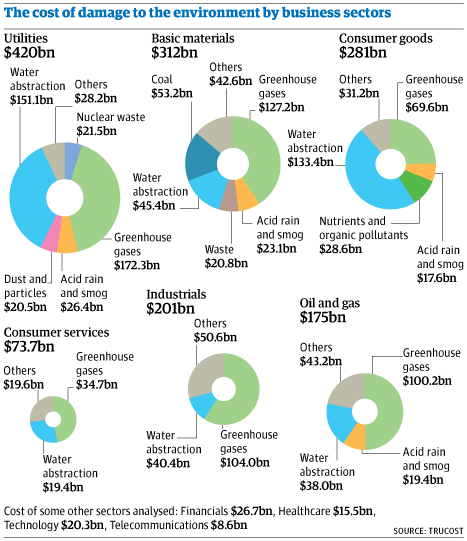
The cost of pollution and other damage to the natural environment caused by the world's biggest companies would wipe out more than one-third of their profits if they were held financially accountable, a major unpublished study for the United Nations has found.
The report comes amid growing concern that no one is made to pay for most of the use, loss and damage of the environment, which is reaching crisis proportions in the form of pollution and the rapid loss of freshwater, fisheries and fertile soils.
Later this year, another huge UN study - dubbed the "Stern for nature" after the influential report on the economics of climate change by Sir Nicholas Stern - will attempt to put a price on such global environmental damage, and suggest ways to prevent it. The report, led by economist Pavan Sukhdev, is likely to argue for abolition of billions of dollars of subsidies to harmful industries like agriculture, energy and transport, tougher regulations and more taxes on companies that cause the damage.
Ahead of changes which would have a profound effect - not just on companies' profits but also their customers and pension funds and other investors - the UN-backed Principles for Responsible Investment initiative and the United Nations Environment Programme jointly ordered a report into the activities of the 3,000 biggest public companies in the world, which includes household names from the UK's FTSE 100 and other major stockmarkets.
The study, conducted by London-based consultancy Trucost and due to be published this summer, found the estimated combined damage was worth US$2.2 trillion (£1.4tn) in 2008 - a figure bigger than the national economies of all but seven countries in the world that year.
The figure equates to 6-7% of the companies' combined turnover, or an average of one-third of their profits, though some businesses would be much harder hit than others.
"What we're talking about is a completely new paradigm," said Richard Mattison, Trucost's chief operating officer and leader of the report team. "Externalities of this scale and nature pose a major risk to the global economy and markets are not fully aware of these risks, nor do they know how to deal with them."
The biggest single impact on the $2.2tn estimate, accounting for more than half of the total, was emissions of greenhouse gases blamed for climate change. Other major "costs" were local air pollution such as particulates, and the damage caused by the over-use and pollution of freshwater.
The true figure is likely to be even higher because the $2.2tn does not include damage caused by household and government consumption of goods and services, such as energy used to power appliances or waste; the "social impacts" such as the migration of people driven out of affected areas, or the long-term effects of any damage other than that from climate change. The final report will also include a higher total estimate which includes those long-term effects of problems such as toxic waste.
Trucost did not want to comment before the final report on which sectors incurred the highest "costs" of environmental damage, but they are likely to include power companies and heavy energy users like aluminium producers because of the greenhouse gases that result from burning fossil fuels. Heavy water users like food, drink and clothing companies are also likely to feature high up on the list.
Sukhdev said the heads of the major companies at this year's annual economic summit in Davos, Switzerland, were increasingly concerned about the impact on their business if they were stopped or forced to pay for the damage.
"It can make the difference between profit and loss," Sukhdev told the annual Earthwatch Oxford lecture last week. "That sense of foreboding is there with many, many [chief executives], and that potential is a good thing because it leads to solutions."
The aim of the study is to encourage and help investors lobby companies to reduce their environmental impact before concerned governments act to restrict them through taxes or regulations, said Mattison.
"It's going to be a significant proportion of a lot of companies' profit margins," Mattison told the Guardian. "Whether they actually have to pay for these costs will be determined by the appetite for policy makers to enforce the 'polluter pays' principle. We should be seeking ways to fix the system, rather than waiting for the economy to adapt. Continued inefficient use of natural resources will cause significant impacts on [national economies] overall, and a massive problem for governments to fix."...
Inserted from <The Guardian>
An externalized cost is the part of the true cost of producing a product or service that the producer is allowed to leave for someone else to pay. Pollution is a prime example, because if taxpayers pay to clean up a toxic waste dump, if others suffer ill health due to exposure to waste products, or if costal cities drown due to global climate change, those costs have or will have been passed on to someone else.
All costs must be included in the cost of all goods and services.
But, but, but… it might put some corporations out of business!
So be it. If the true costs (with all environmental costs internal) of a product or service are so high that there is insufficient demand to support the producer, then that producer ought to fail.
But, but, but… It might cost corporations 1/3 of their profits!
So be it. If internalizing all costs cuts their profits, their profits are too high.
I have no doubt that Republicans will unanimously oppose this idea. How odd. Because what I am arguing here is really nothing more that capitalism in a free market.
For years the GOP, with the complicity of some Democrats, has used our tax code to transfer wealth from the poor and middle classes to the very rich.
For Democrats wavering in their resolve to end the Bush tax cuts for the wealthiest Americans, shocking new data from the IRS should hopefully stiffen their backbones. Between 2001 and 2007, the 400 richest taxpayers doubled their annual incomes to an average of $345 million, while their effective tax rate plummeted to only 16.6% from 29.4% in 1993.
Following recent analyses confirming that income inequality in the United States has reached record levels, noted tax journalist David Cay Johnston summed up the new data, "The incomes of the top 400 American households soared to a new record high in dollars and as a share of all income in 2007, while the income tax rates they paid fell to a record low. The numbers tell the tale of the widening chasm between the rich and everyone else:
In 2007 the top 400 taxpayers had an average income of $344.8 million, up 31 percent from their average $263.3 million income in 2006, according to figures in a report that the IRS posted to its Web site without announcement that were discovered February 16...
Adjusted for inflation to 2009 dollars, the top 400 enjoyed a 27 percent increase in their income, or nine times the rate of increase for the bottom 90 percent...Since 1992, the bottom 90 percent of Americans have seen their incomes rise by 13 percent in 2009 dollars, compared with an increase of 399 percent for the top 400.
Unsurprisingly, the public disclosure of the top 400 report first introduced by the Clinton administration was halted by President Bush (only to be reinstituted by the Obama White House last year). Unsurprising that is, because the sheer size of the massive windfall for America's rich due to the Bush tax cuts would make a Warren Buffet blush.
As the Center for American Progress noted, the Bush tax cuts delivered a third of their total benefits to the wealthiest 1% of Americans. And to be sure, their payday was staggering. The Center on Budget and Policy Priorities detailed that by 2007, millionaires on average pocketed $120,000 from the Bush tax cuts of 2001 and 2003. Those in the top 1% stashed an extra $45,000 a year. As a result, millionaires saw their after-tax incomes rise by 7.6%, while the gains for the middle quintile and bottom 20% of Americans were a paltry 2.3% and 0.4%, respectively. (Other CBPP studies demonstrated that the Bush tax cuts accounted for half of the mushrooming deficits during his tenure in the White House and will continue to do so over the next decade.)
And as the New York Times uncovered in 2006, the 2003 Bush dividend and capital gains tax cuts offered almost nothing to taxpayers earning below $100,000 a year. Instead, those windfalls reduced taxes "on incomes of more than $10 million by an average of about $500,000." As the Times revealed in a jaw-dropping chart, "the top 2 percent of taxpayers, those making more than $200,000, received more than 70% of the increased tax savings from those cuts in investment income." So it should come as no surprise that the income share of the 400 richest Americans doubled over the past decade.
And yet, the usual suspects among the Republican Party (and some quislings among the Democrats) are pleading that the rich should be spared even as their share of the national wealth reaches stratospheric levels…
I have long held that a seldom discussed cause of the Republican recession is this grotesque transfer of wealth. As the filthy rich sucked up more and more of our nation’s wealth, lower and middle class Americans found themselves getting poorer in real terms. Everything was going up except their stagnant wages. The housing bubble would never have occurred, if these Americans, encouraged by smooth-talking predators, had not felt the need to leverage the equity in their homes to educate their children, pay for their sky-rocketing health care premiums, or just maintain their standard of living.
Most economies resemble a pyramid in which a broad base holds up a small capstone. But in today’s GOP rendered economy, the capstone has become so heave that its weight is crushing the base. Until this gross inequity is addressed, there can be no escape from the bubble/crash cycle. The solution is easy enough, if we have the political will to do it. Tax the rich. For example, if rich people had Social Security and Medicare payments deducted from their entire salaries, including bonuses and stock, the solvency issue in those programs would be instantly cured.
As Latin America moves to free their people from US corporate slavery, corporate crimes are finding their way to court.
A federal judge recently refused to dismiss a civil suit filed against Chiquita which charges that the company paid leftist (FARC) guerrillas operating near its plantations in Columbia -- during a period when the FARC killed four American missionaries, according to CNN.
The company's position -- which it has held consistently since it voluntarily disclosed the payments to the Department of Justice -- has been that both left-wing guerrillas and right-wing paramilitaries forced the company in an extortionate manner to make the payments "to protect the lives of its employees."
But that's become an increasingly untenable position -- especially since some of the same paramilitaries who took the payments have come in from the cold, disarming and submitting to Columbia's "Justice and Peace" process -- which allows them to receive reduced jail time for confessing to all of their terrorist crimes. The problem for Chiquita -- and now for Dole (and potentially for Del Monte) -- is that the confessions reveal a much different story.
One of the ex-paramilitaries -- Jose Gregorio Mangones Lugo (aka "Carlos Tijeras") -- was the former commander of the William Rivas Front of the United Defense Forces ("AUC") -- the group that operated in northern Columbia, in the zone where the companies and their suppliers grew bananas. In a sworn statement Tijeras described the AUC's relationship with the multinational banana companies as "an open public relationship" involving everything from "security services" to the kidnapping and extrajudicial assassination of labor leaders fingered by the companies as "security problems."
Tijeras' statement -- which reads like the confessions of a corporate death squad leader and directly refutes his paymasters' version of events -- has now been entered into the record in a case filed against Dole last April in California by attorneys with Conrad and Scherer:
"I've been told that Chiquita has asserted that they paid the AUC funds, but that this was coerced and was a form of extortion. I have also heard that Dole claims to have never paid us any funds. Both of these assertions are absolutely false. In fact, my agreement with Chiquita and Dole was to provide them with total security and other services."
Tijeras is not a lone whistleblower by any means. Salvatore Mancuso, the overall commander of the AUC, also testified in early 2008 that Dole and Del Monte, like Chiquita, had been providing major support to the AUC since its inception. He repeated the accusation to "60 Minutes," which originally aired the segment in September, 2008.
According to these and other witnesses as well as investigators familiar with the bloody history of Columbia, the AUC was originally hired by the companies to drive the leftist FARC guerillas out of the banana-growing region and protect their plantations from "the gangs of common delinquents that robbed their supplies and equipment." (Tijeras) Once the FARC was vanquished and order restored, the banana companies continued to pay the AUC to "pacify" their work force, suppress the labor unions and terrorize peasant squatters seeking their own competing land claims.
Tijeras: "After we restored order and became the local agents of law enforcement, managers for Chiquita and Dole plantations relied upon us to respond to their complaints...We would also get calls from the Chiquita and Dole plantations identifying specific people as "security problems" or just "problems." Everyone knew that this meant we were to execute the identified person. In most cases those executed were union leaders or members or individuals seeking to hold or reclaim land that Dole or Chiquita wanted for banana cultivation, and the Dole or Chiquita administrators would report to the AUC that these individuals were suspected guerillas or criminals."
According to Tijeras, for years the companies provided up to 90% of the AUC's income.
When a case was filed by the families and heirs of dozens of victims against Dole this past April (2009), the company immediately rejected the charges as "baseless allegations" that "are the product of the most untrustworthy sources imaginable" and "nothing more than the false confessions of convicted terrorists from Columbia, who had every motive to lie about their activities in order to minimize their jail time."
(The plaintiffs' complaint is a horrific litany of summary executions, off-the-bus abductions, forced-entry murders and kidnappings, ghoulish disappearances and other crimes committed against trade unionists and land reform activists.)… [emphasis added]
Frankly, I hope these companies are soaked for an arm, a leg, and other body parts that shall remain unmentioned. If ever there were a case that proves that corporations’ special status having the privileges of personhood without the responsibilities needs to be revoked. Greed machines have no soul. Were it up to me, I would extradite the CEO, COO and CFO of each of these companies to Columbia to face trial and imprisonment there. If that means that my three bananas a week double… triple… quadruple in cost. So be it.
I suspect that the upshot of this will be that these corporate criminals will hire the GOP SS, aka Blackwater (now Xe) to commit their murders.
Not much of this is new, but the article provides good overall perspective.
Reckless greed on Wall Street is a dog-bites-man story. Still, the renewed feeding frenzy of the alpha dogs of finance in the embers of the bonfire of their own vanities has inspired amazement and disgust across the political spectrum.
Despite the damage it yet may cause, though, the spectacle does seem to be helping to disarm some of the banksters' ideological weaponry. In the debate over why the financial system collapsed and how to rebuild it, economic assumptions that have enjoyed hegemony for the past 30 years are being questioned, and a swelling chorus is supporting a return to stronger regulation.
David Stockman, President Ronald Reagan's director of the Office of Management and Budget, recently weighed in: "The baleful reality is that the big banks, the freakish offspring of the Fed's easy money, are dangerous institutions, deeply embedded in a bull market culture of entitlement and greed."
Stockman welcomed President Barack Obama's proposed tax on banks because its message is that "big banking must get smaller because it does too little that is useful, productive or efficient."
While the United States economy remains mired in a weak, jobless recovery, the financial sector has used its political clout and government largesse to once again go for the gusto. In the third quarter of 2009, according to economist Dean Baker, finance grabbed 34 percent of all U.S. corporate profits, a far bigger share than at the peak of the housing bubble.
In the political arena, too, Wall Street is back in force. As Congress debates proposals for financial re-regulation, the financiers have cried "Havoc" and let slip the canines of K Street against the reforms.
At Goldman Sachs, the leader of the pack, any embarrassment over the savaging of the global economy is well-hidden. The investment bank, popularly dubbed "Goldman Calf", reportedly has given its employees some 13 billion dollars in bonuses for 2009. That nearly triples its largesse in 2008 when, according to the Wall Street Journal, 953 employees received bonuses of over one million dollars each.
The bank reported earnings of 13.4 billion dollars for 2009, nearly matching the 15 billion dollars combined total of the five other biggest banks. Its net profit margin was 23.85 percent.
Goldman received 10 billion dollars in funds from the U.S. government's Troubled Asset Relief Program in 2008, which it paid back with interest in 2009. The firm also benefited from other forms of government generosity, including an estimated 12.9 billion dollars as a counterparty of AIG.
The failed insurance behemoth used bailout funds to pay off credit default swaps and other complex wagers on bond markets at allegedly inflated values to Goldman and several other U.S. and European financial giants. For some time before the crash, GS had reportedly been betting against the mortgage market.
The apotheosis of Goldman Sachs has relied on a revolving door between the firm and lofty precincts of the federal government. Henry Paulson, the George W. Bush administration's secretary of the Treasury responsible for TARP, formerly served as the firm's CEO. Robert Rubin, Treasury Secretary under President Bill Clinton, and many other power brokers in both major parties are also alumni.
A long year after the industry's near-death experience, Goldman's glass is either full or overflowing, depending on how you look at it. So is popular anger against it. Rolling Stone magazine writer Matt Taibbi celebrated the investment bank as "a giant vampire squid wrapped around the face of humanity, relentlessly jamming its blood funnel into anything that smells like money."
Satirist Andy Borowitz reported tongue-in-cheek that Goldman was in talks to buy the Treasury Department. He quoted an apocryphal Treasury spokesman as saying that the merger would create efficiencies for both because of the high volume of employees and money already flowing back and forth between them. The only hard part, the spokesman said, "is trying to figure out which parts of the Treasury Department we don't already own."
Belatedly, Obama and the Democrats seem to have decided that popular anger on the right and the left churned up by the financial industry may be a political wave they can ride.
In December, the House of Representatives passed a bill that would create an independent financial protection agency for consumers, a measure long lobbied for by Harvard law professor Elizabeth Warren, director of the Congressional Oversight Panel for the bank bailout.
The legislation would also increase banks' capital requirements and limit their leverage, the extent of their reliance on borrowed funds. And by requiring lenders to hold on to some proportion of the loans they make, the law would restrict securitization, the practice of bundling mortgages into complex derivatives that frequently have turned toxic, dragging down financial institutions that hold them.
In the Senate, though, prospects for 60 votes to break a potential filibuster look dubious. Republicans appear to be nearly unanimous in their opposition to the reforms…
I’ve discussed my solutions enough times that I won’t repeat them today, but one thing is clear. The only way to accomplish even minimal banking reform is through reconciliation.
In hope we never become immune to the stories of real people suffering from Big Insurance criminal abuse and from having no health coverage. Sometimes, though the stories are so far removed from human decency that indignation is the only appropriate reaction.
PAUL AND MARIA VanNocker are filing a federal lawsuit today on behalf of their 5-year-old son, Kyler, whose insurance company, HealthAmerica, refuses to pay for the latest treatment needed to prolong his life.
The complaint raises lots of questions that I assume will be answered at trial, should it come to that. The question it won't answer is one that's been gnawing at me since I first wrote of Kyler's plight in December:
How do HealthAmerica's overlords sleep at night?
I know my own dreams would be haunted if I acted as arbitrarily, capriciously and abusively - to borrow some pointed adjectives from the complaint - as the VanNockers allege HealthAmerica has regarding their little boy.
The Harrisburg-based company's denial of benefits to Kyler, the lawsuit claims, is the result of "a biased, self-serving misreading and misinterpretation" of everything from Kyler's medical records to the company's own internal documents.
HealthAmerica's Kendall Marcocci told me yesterday that the company won't comment on pending litigation. Center City attorney David Senoff, though, was happy to explain why he is representing the Van Nockers for free in the lawsuit.
"These companies have to be brought to the courthouse to get them to do the right thing," said Senoff, a specialist in insurance disputes. "This child needs this treatment, or else."
He didn't need to explain what "or else" meant.
Readers may recall that Kyler has neuroblastoma, a rare, deadly childhood cancer that attacks the nervous system, creating tumors throughout his body.
He was diagnosed in 2007 and endured a year of medical treatment, with complications he barely survived. Thankfully, it knocked his cancer into remission for 12 lovely months, and he got to revel once again in the glories of childhood.
Last September, the disease came roaring back. This time, only one form of treatment, something called MIBG therapy, could help save his life.
But HealthAmerica refused to pay for the MIBG, which it considers "investigational/experimental" because there is "inadequate evidence in the peer-reviewed published clinical literature regarding its effectiveness." Nor is MIBG approved by the Food and Drug Administration, another criterion that HealthAmerica requires.
How come, then, asks the lawsuit, HealthAmerica covered not one but two prior therapies for Kyler that did not possess these supposed requirements?
In April 2008, the company approved Kyler's use of a drug to treat a life-threatening blood-flow complication, even though the drug wasn't FDA-approved, wasn't manufactured in the United States and wasn't "peer-reviewed."
However, it was the only known drug to treat Kyler's condition, and he responded well to it. Four months later, HealthAmerica paid for another medication that wasn't FDA-approved for neuroblastoma treatment.
Again, Kyler responded well.
So why, pray tell, is HealthAmerica playing the "experimental therapy" card in the case of the MIBG treatment Kyler now needs? Gee, money couldn't have anything to do with the decision, could it?
In my December column, HealthAmerica's Marcocci was emphatic that her company declined Kyler's MIBG therapy not because of its cost but because of its experimental nature.
But that doesn't mean MIBG is ineffective.
"It's considered the standard of care in Europe and the United States for recurrent neuroblastoma," Kyler's oncologist, Stephan Grupp, told me then. "It's not an unproven treatment with no basis in medical science. Actually, the results are often very good."
Regardless of how you describe MIBG, one thing became clear last week when Paul and Maria got the results of Kyler's latest tests to track his neuroblastoma.
The MIBG is working.
Children's Hospital, where Kyler receives much of his care, proceeded with two rounds of MIBG therapy for Kyler - at a cost of $110,000 - despite the VanNockers' inability to pay for it…
I have nothing but praise for the hospital that saved Kyler’s life with no guarantee of payment. I have nothing but scorn for the insurance company death panel that denied his treatment and for the Republicans and DINOs that are blocking reform.
Meanwhile, the uninsured are still dying at a rate of several 9/11s per year.
Since the unlikely election of Scott Brown in Massachusetts, hardly a day goes by in Washington without a torrent of speculation on what loss of a filibuster-proof majority will mean for the healthcare reform legislation that both houses have already passed. But as the president recently noted, the intense focus on the process of moving the bill over the finish line has done much to obscure the actual human stakes of the policy being debated.
Particularly striking is the near-total absence of the voices of those most acutely affected by the capriciousness of our current healthcare system, the millions who have no insurance. Despite the fact that 30 million of these folks have arguably the largest stake in the legislative outcome, they're almost totally absent from the national conversation over its fate.
Here at The Nation, we have been working to right this in our own small way. We've spent the last two weeks searching for stories from the uninsured. Despite our chosen tools (Twitter and e-mail), or perhaps because of them, we received 185 responses from a diverse group of people. From recent college graduates, to struggling single parents, to recent retirees, the storytellers ranged vastly in age, background and occupation. However, a common thread held them all together: the anxiety and uncertainty that comes with being uninsured.
Many stories expressed great, unshakeable fear that one medical emergency would ruin them. "I would say my wife and I are one medical emergency away from losing everything, but actually I've pretty much resigned myself in my head to the reality that if I have a medical emergency I am going to die," says a used-book seller in California.
The responses included wide array of opinions and varied hopes for the future of healthcare reform, but what an overwhelming majority agreed upon was that the United States government, particularly Congress, had failed to represent them within the debate…
There has been considerable discussion about Obama’s proposed health care summit, on camera, with the GOP. I have commented here and on several other blogs that the Republicans lack the courage to go through with it. The following is an excerpt from a letter to the White House from House GOP leaders, Boehner and Cantor:
...Assuming the President is sincere about moving forward on health care in a bipartisan way, does that mean he will agree to start over so that we can develop a bill that is truly worthy of the support and confidence of the American people? Health and Human Services Secretary Kathleen Sebelius said today that the President is “absolutely not” resetting the legislative process for health care. If the starting point for this meeting is the job-killing bills the American people have already soundly rejected, Republicans would rightly be reluctant to participate.
Assuming the President is sincere about moving forward in a bipartisan way, does that mean he has taken off the table the idea of relying solely on Democratic votes and jamming through health care reform by way of reconciliation? As the President has noted recently, Democrats continue to hold large majorities in the House and Senate, which means they can attempt to pass a health care bill at any time through the reconciliation process. Eliminating the possibility of reconciliation would represent an important show of good faith to Republicans and the American people.
If the President intends to present any kind of legislative proposal at this discussion, will he make it available to members of Congress and the American people at least 72 hours beforehand? Our ability to move forward in a bipartisan way through this discussion rests on openness and transparency.
Will the President include in this discussion congressional Democrats who have opposed the House and Senate health care bills? This bipartisan discussion should reflect the bipartisan opposition to both the House bill and the kickbacks and sweetheart deals in the Senate bill.
Will the President be inviting officials and lawmakers from the states to participate in this discussion? As you may know, legislation has been introduced in at least 36 state legislatures, similar to the proposal just passed by the Democratic-controlled Virginia State Senate, providing that no individual may be compelled to purchase health insurance. Additionally, governors of both parties have raised concerns about the additional costs that will be passed along to states under both the House and Senate bills.
The President has also mentioned his commitment to have “experts” participate in health care discussions. Will the Feb. 25 discussion involve such “experts?”
Will those experts include the actuaries at the Center for Medicare and Medicaid Services (CMS), who have determined that the both the House and Senate health care bill raise costs – just the opposite of their intended effect – and jeopardize seniors’ access to high-quality care by imposing massive Medicare cuts? Will those experts include the non-partisan Congressional Budget Office, which has stated that the GOP alternative would reduce premiums by up to 10 percent? Also, will Republicans be permitted to invite health care experts to participate?
Finally, as you know, this is the first televised White House health care meeting involving the President since last March. Many health care meetings of the closed-door variety have been held at the White House since then, including one last month where a sweetheart deal was worked out with union leaders. Will the special interest groups that the Obama Administration has cut deals with be included in this televised discussion?… [emphasis original]
You can find this on the House Republican Leader website. I refuse to provide that goose-stepper linkage.
Assuming the President is sincere is a backhanded way of saying that, if Obama does not answer ‘Yes’ to all the questions, he mist not be sincere. Then this convoluted logic follows that, if he is not sincere, there is no basis for a meeting. In short, these are demands to which Obama must agree, or there will be no televised meeting.
I’m not the only one who thinks so. Consider what Keith Olbermann and Ezra Klien have to say:
Just for the sake of absurdity, lets assume that Obama were to accede to these demands. What would happen? The GOP would agree to only two reforms. First, allow insurance companies to sell across state lines. In the absence of federal regulation, only state regulation now holds insurance abuses in check, and that in some states only. This reform would allow insurance companies to sell only in states with no regulation, thus circumventing what state regulation there is now and freeing them to commit even more abuses. Second, they want tort reform to allow insurance companies to form networks of providers offering sub-standard care, but immune from suit for their malpractice. This is the GOP solution.
Boehner and Cantor are asking Obama to surrender in advance of the meeting. Were they to make these absurd demands to Harry Reid, I trust he would give-in. But Obama will not, and the Republicans know it. Therefore, this whole elaborate scheme is nothing but a ploy to avoid the meeting in which they would make fools of themselves on camera.
Do you remember John Thain and his infamy? Like fair-weather friends on payday, he’s back.
John Thain is getting a second chance.
CIT Group Inc., the lender that is trying to regain its former stature after almost collapsing during the financial industry crisis, said late Sunday it has hired the former Merrill Lynch & Co. CEO as its chairman and chief executive.
Thain is also trying to repair his own image. He brokered Merrill's sale to Bank of America Corp. as the credit crisis peaked in the fall of 2008, but was forced to resign after the deal closed because of controversy over employee bonus payments and mounting losses at the investment bank.
CIT, which lends to more than 3,000 businesses including supermarkets and department stores, went through bankruptcy reorganization late last year after it failed to restructure billions of dollars in debt. It was also hurt by rising loan losses as more customers fell behind on repaying loans.
Thain, 54, is taking over a company that has seen its business shrink dramatically as customers fled. He'll have to find a way to bring in new customers. And he'll have to find new sources of funding because short-term lending known as commercial paper essentially disappeared during the credit crisis and has yet to revive.
Analysts say Thain's experience makes him an ideal candidate to rebuild CIT's business. He was able to get Merrill shareholders the best possible price for their stock in the Bank of America deal. And as CEO of the New York Stock Exchange, he expanded the stock market through a series of mergers and acquisitions.
"He's taking on an extremely challenging situation," said Steve Hagenbuckle, managing principle of private equity fund TerraCap Partners. "If he survives and rights the ship, then I think his legacy has been written. It's a perfect storm to come out a hero or come out a failure."
Thain took over Monday. He replaced interim CEO Peter Tobin, who will remain on CIT's board of directors. Tobin had served as CEO since Jeffrey Peek retired Jan. 15.
Hal Reichwald, co-chair of the banking and specialty finance practice group at the law firm Manatt, Phelps & Phillips LLP, said Thain's job will be made easier by the fact that few other lenders picked up the business the company lost as it headed toward bankruptcy.
"No institution has stepped up to challenge CIT," Reichwald said. That could be because banks are still tentative about lending.
"The marketplace needs a CIT," Reichwald said. But, he said, CIT can only be viable long-term if it finds new sources of funding.
Thain, a former president of Goldman Sachs Group Inc., might have been brought in because of his extensive connections on Wall Street. His experience in investment banking may help CIT find a new partner or even parent, Hagenbuckle said.
CIT will pay Thain an annual cash salary of $500,000. He will also receive $5.5 million in stock annually, of which $2.5 million will be subject to a one-year holding period. The remaining $3 million cannot be sold for three years.
Thain could also receive up to $1.5 million in bonuses based on the performance of the company. The board will determine whether to award the performance-based bonuses.
Thain's deal to sell Merrill was considered a lifesaving move at the height of the financial crisis. But he was criticized for having paid out $3.6 billion in bonuses to Merrill employees just before the deal closed, and for spending more than $1 million to redecorate his office at Merrill despite its massive losses.
Thain resigned as head of global wealth management of the combined company in January 2009, after news of the bonus payments surfaced. Bank of America last week agreed to settle a case with the Securities and Exchange Commission over claims it misled shareholders about the bonuses and more than $15 billion in fourth-quarter losses at Merrill to ensure the deal would be approved… [emphasis added]
It seems that no matter how much these banksters fail, no matter how far their companies fall, and no matter out outrageous their abuse, they always have a multi-million dollar job waiting.
Last week, right-wing web and radio and the GOP Reichsministry of Propaganda, Faux Noise, have been parroting a false claim in Reuters that the Obama administration has embedded hidden tax increases for most Americans in the budget. No doubt this wing-nut media frenzy will continue, because they are counting on public ignorance of this:
The journalist who wrote an article on Monday that turned into an embarrassment for Reuters has left the wire service, the company said Friday. A Reuters spokeswoman declined to say whether the journalist, Terri Cullen, left voluntarily, or why. “I can’t really go into any detail,” said the spokeswoman, Courtney Dolan.
Ms. Cullen stepped down less than a month after being hired for the newly created position of wealth management editor. She had worked for more than a decade for The Wall Street Journal Online.
Her article said that President Obama’s budget amounted to a backdoor tax increase for middle-income and even lower-income people, based largely on the scheduled expiration of income tax cuts passed in 2001. But the president had actually proposed keeping those cuts in place for all but high-income families. [$250,000 up]
After a complaint from the White House, Reuters withdrew the article, stating that it was inaccurate. But by then, some prominent conservatives had seized on the article, and a few — notably Rush Limbaugh — insisted that the retraction meant simply that the media were protecting the president.
Now, stripping away the diplomatic niceties, what we see is this. A Rupert Murdoch operative from one of his propaganda outlets (WSJ) infiltrated a respectable news wire (Reuters) to plant the GOP’s favorite big lie: “Obama will raise your taxes.” Reuters, properly chagrined, retracted the story and fired the liar. No matter. The damage is done. You can be sure that Terri Cullen will resurface somewhere in Murdoch’s media empire. I am also confident that we will have to counter this claim with the facts over and over throughout the Presidential campaign of 2012, The only lower and middle class tax Obama has supported is the smokers tax in SCHIP. He would have been better served to tax Big Tobacco directly.
Senator Chris Dodd, the chairman of the Senate Banking Committee, scolded Wall Street representatives at a hearing Thursday for sending “an army of lobbyists whose only mission is to kill the common-sense financial reforms” needed by the public. “The fact is,” Dodd said, “I am frustrated, and so are the American people.” He charged that Wall Street’s intransigence was the reason for Congress’s failure to pass any bill to regulate the Street. “The refusal of large financial firms to work constructively with Congress on this effort borders on insulting to the American people who have lost so much in this crisis.”
In other words, it isn’t Congress’s fault. It isn’t the Senate Banking Committee’s fault. It certainly isn’t Dodd’s fault. The reason more than a year has passed since the biggest bailout in the history of the world and nothing has been done to prevent a repeat performance — even as the biggest banks are doling out more than $30 billion of bonuses, even as Goldman Sachs is awarding its big traders $16 billion in bonuses (more than the $13 billion Goldman collected from taxpayers via the bailout of AIG), even as AIG itself is handing out bonuses — the reason is … what, exactly, Senator? Because the Street has sent an army of lobbyists to Capitol Hill?
Call me old fashioned, but I thought Congress was in charge of passing legislation, not Wall Street.
Dodd left out the most telling detail, of course. Wall Street is where the campaign money is. Dodd of all people knows that. He’s been on the receiving end of lots of it over the years.
Wall Street firms and their executives have been uniquely generous to both political parties, emerging recently as one of the largest benefactors of the Democratic Party. Between November 2008 and November 2009, Wall Street firms and executives handed out $42 million to lawmakers, mostly to members of the House and Senate banking committees and House and Senate leaders. During the 2008 elections, Wall Street showered Democratic candidates with well over $88 million and Republicans with over $67 million, putting the Street right up there with the insurance industry as among the nation’s largest equal-opportunity donors.
Some Democrats are quietly grumbling that all the tough talk emanating from the White House in recent weeks — the President calling the Street’s denizens “fat cats” and threatening them with limits on their size and the risks they can take, even waiving a watered-down version of Glass-Steagall in their faces — is making it harder to collect money from the Street this mid-term election year. And the Street is quietly threatening that it may well give Republicans more, if the saber-rattling doesn’t stop.
Congress isn’t doing a thing about Wall Street because it’s in the pocket of Wall Street. Dodd’s outburst at the Street is like the alcoholic who screams at a bartender “how dare you give me another drink when all I’ve done is pleaded with you for one!”…
He’s right. We have the best Congress money can buy… and has. The only way to return government to the people is 100% public financing, at least at the federal level. Until and unless we accomplish that goal, Congress will represent those who bought them, not those whop voted them in.
On the issue of corporate advertising, Donna Edwards says no.
Maryland Congresswoman Donna Edwards turned to Supreme Court Justice Louis Brandeis for guidance in framing the Constitutional amendment she proposed Tuesday as the right and necessary response to the decision by Chief Justice John Roberts and a high court majority to abandon law and precedent with the purpose of permitting corporations to dominate the political discourse. "We can have democracy in this country, or we can have great wealth concentrated in the hands of a few, but we can't have both," said Brandeis, the lion of law whose defenses of freedom of speech and the right to privacy renewed and extended the American experiment in the 20th century. Brandeis knew that giving corporations monopoly powerover our economic life or our politics would be deadly to democracy. Unfortunately, that truth is lost on the current Supreme Court's activist majority. Edwards is relying on Brandeis as an intellectual and legal touchstone as she launches the boldest congressional response yet to last month's Supreme Court decision in the case of Citizens United v. FEC. "The ruling reached by the Roberts' Court overturned decades of legal precedent by allowing corporations unfettered spending in our political campaigns. Another law will not rectify this disastrous decision," Edwards said Tuesday. "A Constitutional Amendment is necessary to undo what this Court has done. Justice Brandeis got it right: ‘We can have democracy in this country, or we can have great wealth concentrated in the hands of a few, but we can't have both.' It is time we remove corporate influence from our policies and our politics. We cannot allow corporations to dominate our elections, to do so would be both undemocratic and unfair to ordinary citizens." Edwards explains the amendment in a powerful video where says: "You don't amend the Constitution often, but the Supreme Court really has left us with no choice but to change the Constitution and make sure that people own our government and our elections -- not the corporations." Edwards does not stand alone. In addition to an array ofpublic interest groups including Public Citizen, Voter Action, The Center for Corporate Policy and the American Independent Business Alliance,the congresswoman's proposed amendment is being backed by House Judiciary Committee chair John Conyers, the Michigan Democrat who is the dean of civil libertarians in Congress. Conyers has signed on as an original co-sponsor of the amendment to address the court's move to allow corporations to spend unlimited amounts of money on elections. "The Supreme Court's idea that corporate political speech is no different than an individual citizen's political speech was not the law when the Constitution was written, was not the law before the Supreme Court's decision two weeks ago, and should not be the law in the future," says Conyers. "I look forward to working further with Ms. Edwards and my other colleagues to use every tool at our disposal to make sure that elected representatives are accountable to voters, not corporations."…
Click through to the article for the full text of the amendment.
For the long term, I agree with Edwards, but think she should go ever further to address that earlier wrongful decisions that a corporation is a person and that political expenditure equals speech.
For the short term, we need a law to serve as a poison pill to corporate spending. Congress maintains the power to tax corporate activity. I propose a 500% tax on all corporate spending for advertising, with the receipts split evenly between reducing the national debt and the funding the campaign committee of the opposing party. Here’s a hypothetical example. Let’s say Goldman Sachs spends $1 million in eleventh hour smear ads against Donna Edwards. The Extreme Court decision makes it impossible to block the ads, Edwards is defeated. Then Goldman Sachs has to pay a $5 million tax assessment. Of that, $2.5 million goes to reduce the national debt, and $2.5 million goes to the DNC. Thus, every time corporations try to buy an election, they provide 2.5 times what they spend on that to fund the campaigns of opponents and, at the same time, help pay down the national debt they created with the help of the GOP. What do you think of both ideas, hers and mine?
I'm just a retreaded activist from the 1960s trying to promote progressive values one day at a time, remove the GOP stranglehold on our nation, and insist that Democrats stop acting like Republicans.